
If you want to know what HR professionals and internal recruiters are really thinking in 2026, you won’t find it on LinkedIn. LinkedIn is for employer branding; Reddit is for reality.
To understand the friction points of the modern global hiring market, Mediapod analyzed unfiltered conversations from the world’s most active HR communities (r/humanresources, r/recruiting, and r/AskHR) between January and May 2026.
By categorizing and analyzing the sentiment of these anonymous discussions, a clear narrative emerged: internal talent teams are severely burnt out, candidate quality is dropping, and the relationship with external agencies is more complicated than ever.
Here is the data-driven breakdown of the 2026 talent squeeze.
1. The Sourcing Nightmare: Ghosting and Candidate Quality
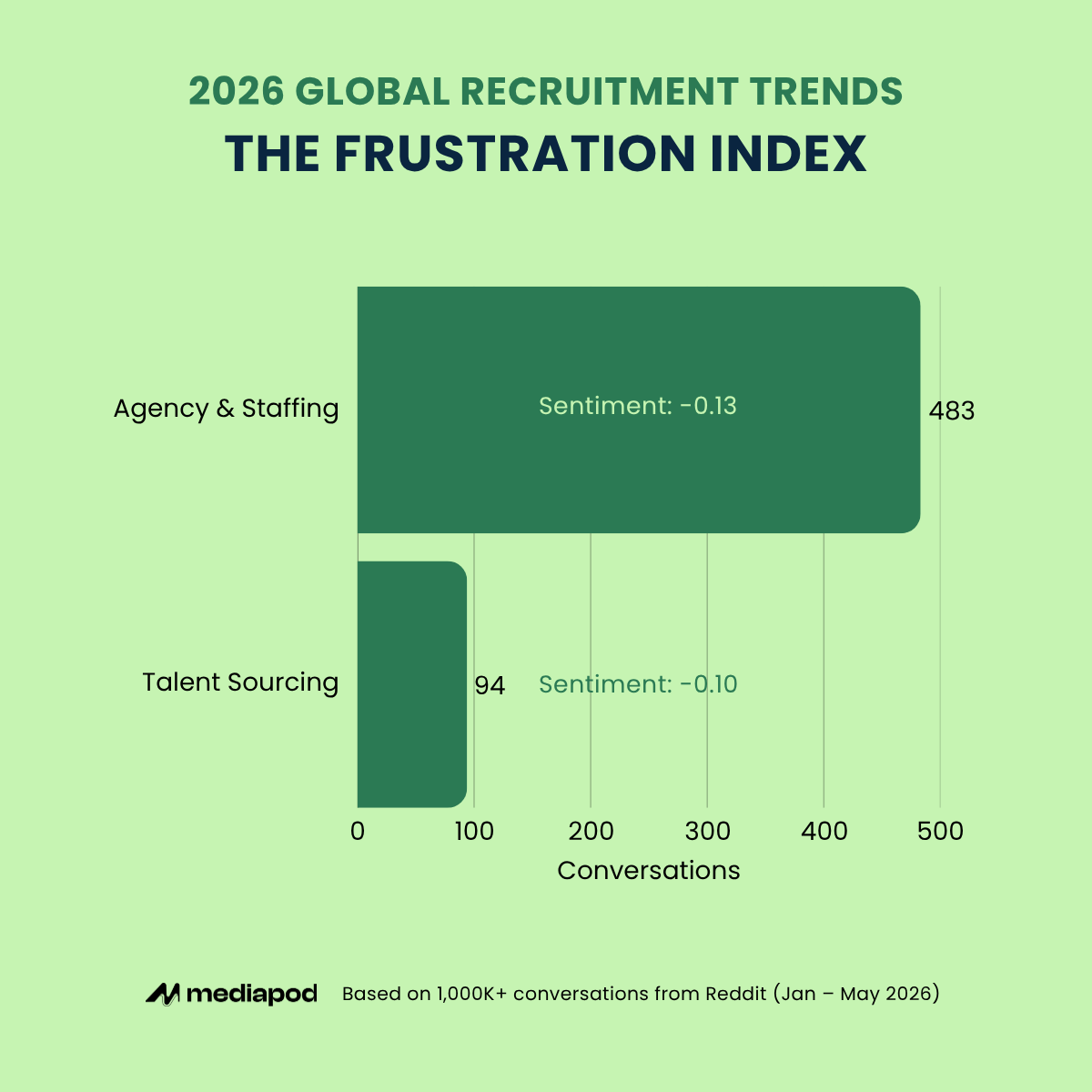
Finding talent is no longer the issue—finding reliable talent is. Conversations categorized under HR Talent Sourcing generated 94 unique discussions with a highly negative average sentiment score of -0.10.
A deep dive into these threads reveals that “Ghosting” has become an epidemic. Internal recruiters are consistently complaining about candidates abandoning the process midway through, failing to show up for final-round interviews, or even ghosting on their first day of work. Alongside ghosting, “candidate quality” is a massive pain point. Teams are overwhelmed by hundreds of AI-generated resumes for every open role, making the actual screening process slower and more exhausting than in previous years.
The Strategic Insight: The power dynamic in recruitment is highly fragmented. While lower-level roles are seeing a flood of unqualified applicants, top-tier talent knows exactly how much leverage they hold—and they aren’t afraid to walk away without a word. For HR tech companies, this data proves that tools promising “more applicants” are missing the mark. Internal teams don’t want more volume; they want advanced filtering and candidate-intent verification.
2. The Agency Love/Hate Relationship
When internal sourcing fails, companies turn to external headhunters. Conversations surrounding HR Agency & Staffing were the most dominant in our dataset, driving a massive 483 unique discussions with an average sentiment of -0.13.
The relationship between internal HR and external agencies is highly transactional and fraught with friction. Internal teams frequently vent about external recruiters aggressively pushing mismatched candidates, refusing to take “no” for an answer, or spamming hiring managers directly to bypass HR.
However, the data also reveals exactly when internal teams finally cave and hire an agency. The trigger is almost always tied to the sourcing nightmares mentioned above: niche technical roles that have been open for over 60 days, or a sudden hiring spike where the internal team simply lacks the bandwidth to screen candidates.
What This Means for Staffing Agencies: If you are an external recruiter, this data is your ultimate pitch playbook. Internal HR teams are not looking for someone to “send over a few CVs.” They are looking for someone to absorb their stress.
To win B2B contracts in 2026, agencies need to stop pitching their “massive talent pool” (which internal teams view as a screening headache) and start pitching their candidate retention and vetting processes. Promising an internal HR manager that you will deliver three highly-vetted candidates who are guaranteed to show up to the interview is far more effective than promising them fifty resumes.
The Bottom Line
The 2026 hiring landscape is defined by operational exhaustion. Internal talent teams are drowning in a sea of poor-quality applications and unpredictable candidate behavior. External agencies and HR tech platforms that can successfully position themselves as “burnout relievers” rather than just “resume providers” will win the lion’s share of the global recruitment budget this year.