
This is part of our Malaysia Higher Education Market Intel 2026 article series:
- Public vs. Private: Which Malaysian Universities Dominate the Reddit Reality Check?
- The Pragmatic Generation: The Most Discussed University Degrees on Reddit
- Scholarships, PTPTN, and Panic: The Financial Realities of Malaysian Students
- Hostels, Timetables, and Toxic Lecturers: The Unfiltered Reality of Campus Life
If you look at the glossy brochures of Malaysian universities, the focus is almost entirely on state-of-the-art facilities, vibrant campus life, and Olympic-sized swimming pools.
However, if you look at what students are actually discussing online, a much grimmer picture emerges.
To understand the economic pressures facing Gen Z, Mediapod analyzed the “Career & Finance” conversations within our 2026 higher-education Reddit dataset. By deduplicating the data to track unique, individual student threads, we isolated exactly what is keeping prospective students—and their parents—awake at night.
The data reveals that for the modern Malaysian student, choosing a university is no longer about prestige or passion. It is a calculated, high-stakes financial equation.
1. The Desperate Hunt for Scholarships
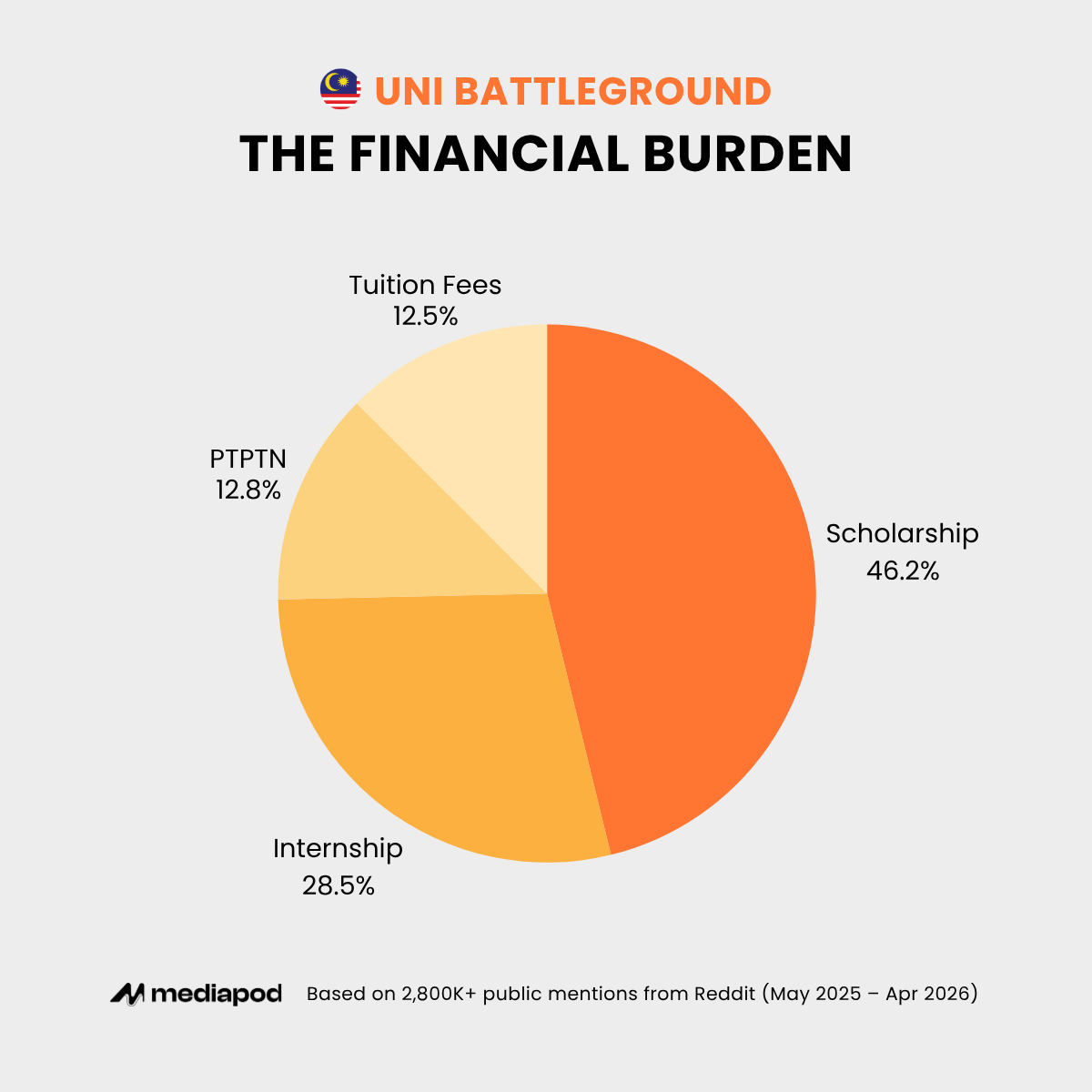
In a macroeconomic climate marked by inflation and rising living costs, price sensitivity is at an all-time high. “Scholarships” is overwhelmingly the number one financial topic, driving 133 unique conversations.
On platforms like r/malaysiauni, students aren’t just casually asking about financial aid; they are rigorously comparing the minimum GPA requirements to maintain scholarships at various private institutions. Many threads feature students actively pitting universities against each other, asking peers which institution is less likely to revoke a scholarship if their grades slip during their second year.
The Strategic Insight: Universities that bury their financial aid information deep within their websites are losing prospective students at the top of the funnel. Because the anxiety around funding is so high, marketers need to position scholarships and bursaries front and center in their digital ad campaigns. Transparency regarding the maintenance requirements of these scholarships is a massive, untapped trust-building tool.
2. Internships as the New Degree
Traditionally, students only started worrying about employment during their final semester. Today, that anxiety starts on day one. “Internships” generated 82 unique conversations, far outpacing discussions about actual postgraduate “Job Prospects” (18 conversations).
Students are heavily scrutinizing the industry connections of different universities. They are actively debating whether a degree from a top-tier public university (like Universiti Malaya) provides better internship placements at multinational corporations (MNCs) compared to premium private universities.
What This Means: Gen Z views the degree itself merely as a baseline requirement. They believe the internship is what actually secures the job. Higher-ed marketers must pivot away from vague claims of “high employability rates.” Instead, they should heavily advertise specific corporate partnerships, guaranteed internship placement programs, and alumni networking events.
3. The PTPTN vs. Tuition Fee Calculation
Discussions surrounding “PTPTN” (37 conversations) and “Tuition Fees” (36 conversations) are deeply intertwined.
The sentiment in these threads is highly pragmatic and often cynical. Students are actively calculating the exact debt burden they will face upon graduation. A common recurring theme is the “Public vs. Private ROI debate”—specifically, whether taking out a massive PTPTN loan to cover a RM100,000+ private university degree is justifiable given the current starting salaries in Malaysia.
Students are crowd-sourcing advice on PTPTN loan exemptions (specifically for achieving First Class Honours) and warning each other about hidden campus fees that aren’t listed in the official prospectuses.
The Bottom Line for Higher-Ed Marketers: Financial anxiety is the biggest friction point in the enrollment journey. Universities that fail to acknowledge this reality risk coming across as tone-deaf to the economic struggles of the middle class.
To win over this highly pragmatic generation, universities must transition their marketing from “selling an experience” to “proving a return on investment.” By using social listening to understand these exact financial pain points, institutions can tailor their messaging to provide the reassurance—and the hard numbers—that students desperately need before they sign on the dotted line.
🎓 See the Full Higher Education Intel
This insight is just one piece of the syllabus.
From APU’s tech disruption to the “Lecturer Lottery” and PTPTN panic, we analyzed nearly 3,000 unfiltered Reddit conversations to map the real 2026 Malaysian student journey.
Stop relying on glossy brochures. Get the complete data story.
Read the Full “Malaysia Higher Education Market Intel 2026” Report