

Hiring remote talent globally sounds like the ultimate corporate hack—until the payroll and legal reality sets in.
While C-suite executives focus on the cost-saving benefits of an offshore workforce, the internal HR teams are the ones left untangling the massive web of international labor laws. To understand the friction points of this “borderless” shift, Mediapod analyzed unfiltered conversations from the world’s most active HR communities (r/humanresources, r/recruiting, and r/AskHR) between January and May 2026.
By extracting the specific discussions around global expansion and labor laws, a stark reality emerged: HR professionals are drowning in legal anxiety, and the Employer of Record (EOR) industry is booming as a direct result.
Here is what is really happening behind the scenes of global remote work.
1. The Compliance Nightmare
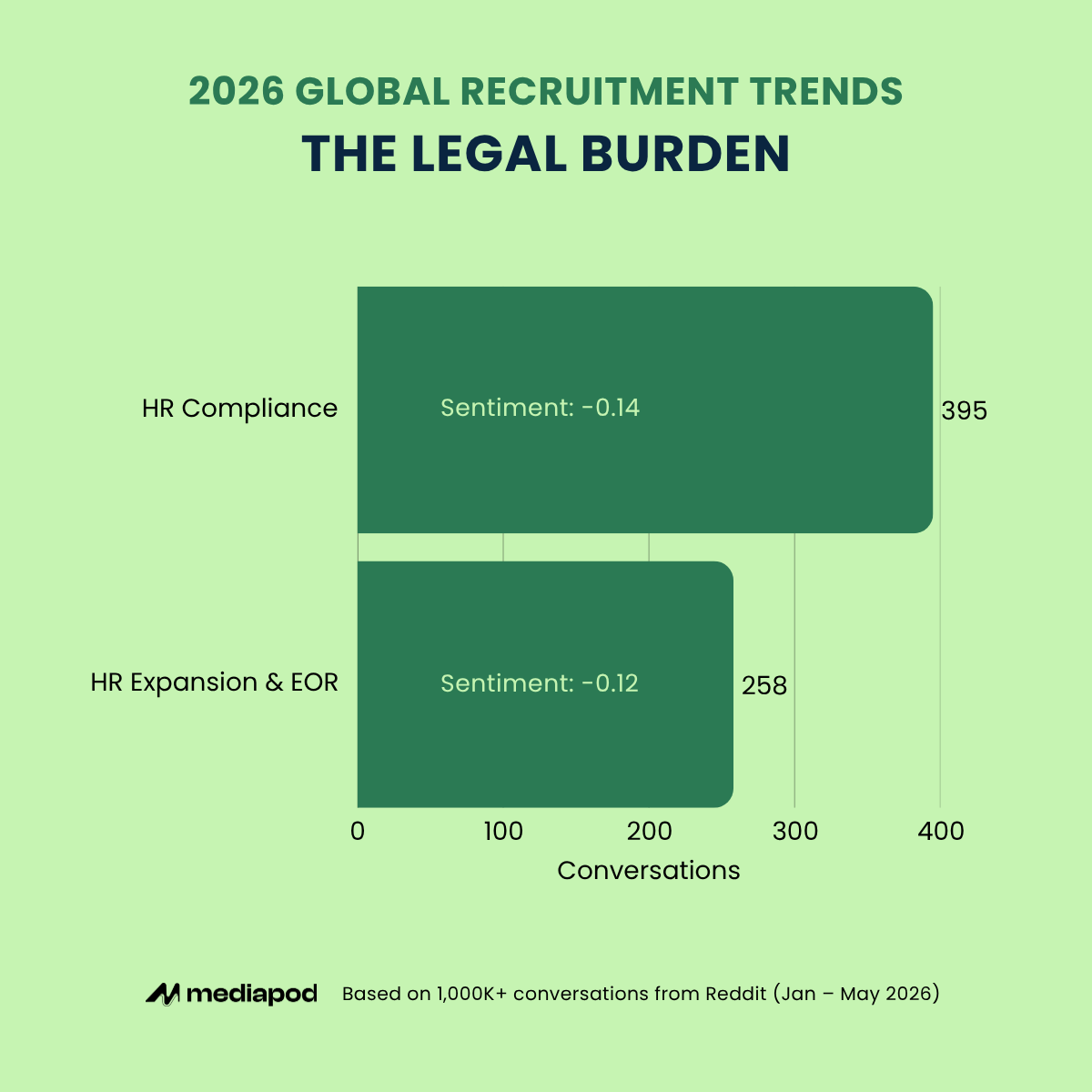
Nothing causes more stress for an HR professional than the threat of a lawsuit or a government audit. Conversations categorized under HR Compliance dominated this subset of our data, generating 395 unique discussions with a highly negative average sentiment score of -0.14.
The Reddit threads are filled with panicked questions and frantic troubleshooting. Internal teams are heavily debating the nuances of “statutory benefits,” navigating localized “employment acts,” and figuring out how to legally process “severance” for remote workers in countries where the company doesn’t even have a registered office. Misclassifying an international contractor as a full-time employee is a recurring, high-anxiety theme that keeps HR managers awake at night.
The Strategic Insight: HR teams do not have the bandwidth—or the localized legal expertise—to keep up with the ever-changing labor laws of 50 different countries. They are acutely aware of the financial risks of getting payroll wrong. For B2B legal consultants and compliance software providers, this data shows that fear is your biggest lever. You aren’t just selling software; you are selling legal protection and peace of mind.
2. The EOR Boom (and Confusion)
To bypass the compliance nightmare, companies are increasingly outsourcing the legal heavy lifting. Conversations surrounding HR Expansion & EOR (Employer of Record) generated an impressive 258 discussions, operating at an average sentiment of -0.12.
While the EOR model (where a third-party company legally employs the worker on your behalf) is becoming the standard for global expansion, it is not without friction. Internal HR teams are actively comparing EOR vendors on Reddit, complaining about hidden offshore fees, clunky global payroll integrations, and poor customer support when a localized payroll issue inevitably arises.
Many threads feature HR professionals asking a very specific question: “At what headcount does it make financial sense to drop our EOR and just set up our own local entity?”
What This Means for EOR Providers: The market is maturing. HR teams are no longer asking what an EOR is; they are rigorously evaluating which EOR is the most reliable. To win in 2026, EOR providers need to pivot their marketing away from “hire anyone, anywhere” (which is now just a baseline expectation) and focus heavily on pricing transparency and premium localized support. The data shows that HR teams will actively churn and switch EOR vendors if their offshore employees experience a single payroll delay.
The Bottom Line
The “borderless workforce” is here to stay, but the operational infrastructure is still catching up. As companies aggressively hire offshore to reduce costs, the burden of international compliance has pushed internal HR teams to their breaking point. The B2B vendors—whether EORs, global payroll platforms, or compliance consultants—that can successfully absorb this legal risk and offer flawless execution will dominate the HR tech stack in 2026.